-
 Anglický jazyk
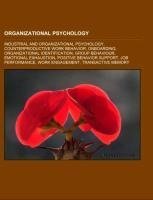
Organizational psychology
Autor: Source: Wikipedia
Source: Wikipedia. Pages: 48. Chapters: Industrial and organizational psychology, Counterproductive work behavior, Onboarding, Organizational identification, Group behaviour, Emotional exhaustion, Positive behavior support, Job performance, Work engagement,... Viac o knihe
Na objednávku, dodanie 2-4 týždne
16.82 €
bežná cena: 17.70 €
O knihe
Source: Wikipedia. Pages: 48. Chapters: Industrial and organizational psychology, Counterproductive work behavior, Onboarding, Organizational identification, Group behaviour, Emotional exhaustion, Positive behavior support, Job performance, Work engagement, Transactive memory, Transformational leadership, Organisation climate, Happiness at work, Cognitive complexity, Stewart Donaldson, Affect measures, Perceived organizational support, Cultural Intelligence, Perceived psychological contract violation, Positivity/negativity ratio, Leader-Member Exchange Theory, Positive organizational behavior, Embeddedness, Biodata, Professional identification, Organizational commitment, Gay friendly, Power process, MARS model of individual behavior, OPQ, Transactional leadership, Snakes in Suits: When Psychopaths Go to Work, Maple syrup event, Malicious compliance. Excerpt: Industrial and organizational psychology (also known as I-O psychology, industrial-organizational psychology, industrial psychology, work psychology, organizational psychology, or personnel psychology) is the scientific study of employees, workplaces, and organizations. Industrial-organizational psychologists contribute to an organization's success by improving the performance and well-being of its people. An I-O psychologist researches and identifies how behaviors and attitudes can be improved through hiring practices, training programs, and feedback systems. I-O psychology can also be viewed as the equivalent of the economics concept of human capital. An applied science, I-O psychology is represented by Division 14 of the American Psychological Association, known formally as the Society for Industrial and Organizational Psychology (SIOP). Guion (1965) defines I-O psychology as "the scientific study of the relationship between man and the world of work: ... in the process of making a living" (p. 817). Blum & Naylor (1968) define it as "simply the application or extension of psychological facts and principles to the problems concerning human beings operating within the context of business and industry" (p. 4). I-O psychology has historically subsumed two broad areas of study, as evident by its name, although this distinction is largely artificial and many topics cut across both areas. It has roots in social psychology; organizational psychologists examine the role of the work environment in performance and other outcomes including job satisfaction and health. Sometimes, I-O psychology is considered a sister field or branch of organizational studies, organizational science, organizational behavior, human resources, and/or management, but there is no universally accepted classification system for these related fields. Common research and practice areas for I-O psychologists include: I-O psychologists are trained in the "scientist-practitioner" model. The training enab
- Vydavateľstvo: Books LLC, Reference Series
- Rok vydania: 2012
- Formát: Paperback
- Rozmer: 246 x 189 mm
- Jazyk: Anglický jazyk
- ISBN: 9781156554913